How Product Discovery is Changing in 2026
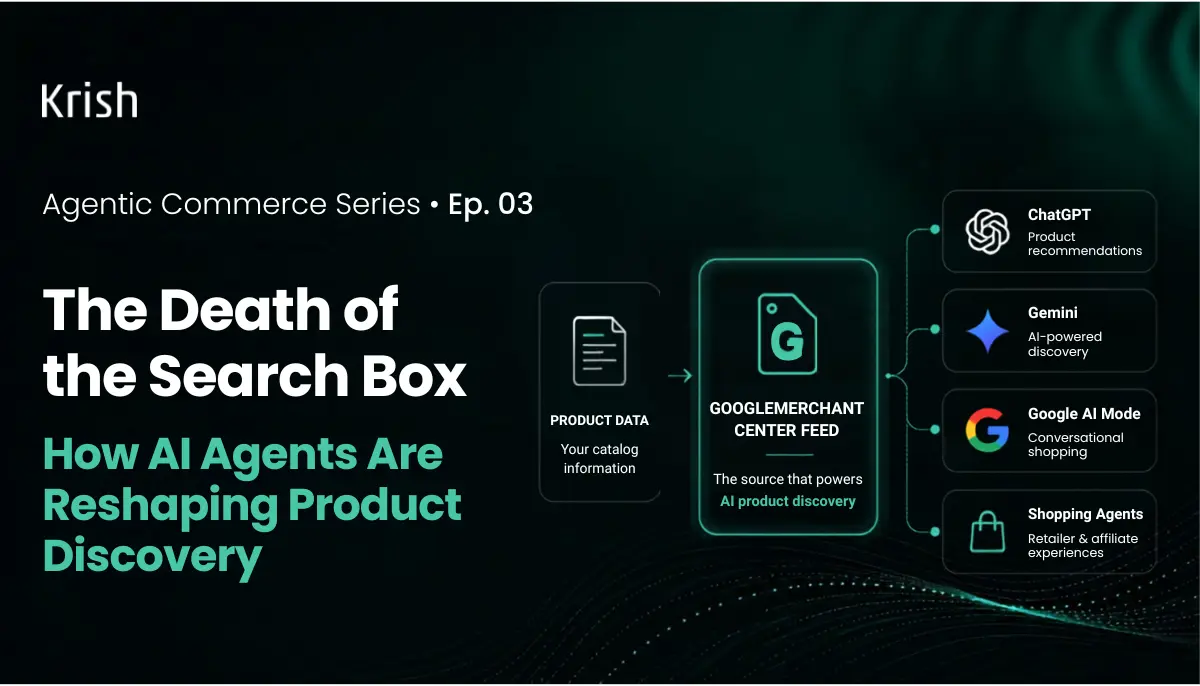
Your Google Merchant Center feed is already powering ChatGPT’s product recommendations. Most brands have no idea.
In November 2025, researchers at Peec AI found base64-encoded Google Shopping parameters buried inside ChatGPT’s source code. They decoded the field, reconstructed the Google Shopping URLs, and confirmed what the industry had long suspected but never proven at scale: ChatGPT is not building product carousels from scratch. It is pulling directly from Google’s organic Shopping results.
Tom Wells at Search Engine Land published the full study in March 2026: 43,000 ChatGPT carousel products across 10 verticals, compared against 200,000+ organic shopping results from Google and Bing.
The finding: 83% of ChatGPT carousel products match Google’s top 40 organic Shopping positions. Bing accounts for just 11%, and of those, only 70 products across the entire dataset were exclusively found on Bing and not Google.
This single data point should restructure how every ecommerce team allocates its time and budget. The feed you treat as an operational compliance task is already the primary input determining whether ChatGPT recommends your products to 900 million weekly users.
That is where product discovery in 2026 actually begins.
In Episode 01, we defined agentic commerce. In Episode 02, we covered what it does to your storefront. This episode is about where product discovery actually lives now, and what your catalog needs to do to show up there.
Why Keyword Search Lost the Queries That Matter Most
The search bar did not fail. It just hit a structural ceiling it was never designed to clear.
Traditional search runs on inverted indexes and term-frequency algorithms – TF-IDF and BM25. The engine maps words in a query to words in a document. It does not understand the meaning. It matches terms. Ask for “shoes for bad knees” and it returns shoes. The word “orthopedic” was not in the query, so products tagged with it do not surface. The buyer’s language and the catalog’s language diverged, and nobody told the system they meant the same thing.
The result: traditional keyword search misses 40 to 60% of potential product matches due to vocabulary gaps between how customers describe what they want and how catalogs are written. That is not a fringe failure rate. That is the model working as designed, and the design has a fundamental limitation.
Gartner predicts traditional search engine volume will drop 25% by 2026 as AI assistants absorb more queries. The queries migrating first are not the head terms. They are the long, specific, high-intent briefs where keyword search was always most limited and where purchase decisions are most often made.
What Natural Language Commerce Actually Means
Here is the shift in plain terms: Keyword search forces buyers to translate their actual need into terms a machine can match. The buyer has to guess what words your catalog uses. If their guess is wrong, the match fails.
Conversational AI flips the model. The buyer says what they actually mean. The system figures out what products match it.
Courtney Rose, VP of Google Ads, confirmed in an April 2026 interview with Retail TouchPoints that search queries in AI Mode are already 2 to 3 times longer than traditional searches. That is not people typing more. That is people finally being able to say what they need because the system understands intent, not just vocabulary.
- “Find trail running shoes for a beginner with flat feet who runs twice a week, size 10, budget $100” is not a query. It is a brief. Experience level, foot type, terrain, frequency, size, and budget parsed simultaneously, applied as a single coherent filter set, returning products that fit the whole brief, not just the most keywords in it.
The underlying mechanism is transformer-based vector search: text encoded into numerical vectors that capture semantic meaning, not just word frequency.
- When a buyer says “waterproof jacket for sailing,” the system does not search for those exact words. It finds products whose vector representations are semantically closest to the concept of outdoor, wet-condition, technical performance gear, regardless of whether their descriptions use the same words.
AI-assisted commerce sessions show a 2- to 3-times higher conversion rate because the AI has already pre-sold the customer by addressing their specific objections before they arrive. The buyer who reaches your product page via an AI recommendation is not browsing. They have already decided. The storefront’s job is to confirm, not convince.
How AI Agents Actually Discover Your Products
Understanding the discovery pipeline at the technical level is what makes the product data requirements concrete rather than abstract.
The earlier-mentioned Peec AI study adds a critical positional detail to stage two: 60% of ChatGPT carousel matches come from the top 10 Google Shopping positions, and 84% from the top 20. Products ranked 21 to 40 account for only 16% of carousel appearances.
If your product is not ranking in Google Shopping’s top 20 for a relevant query, it is effectively outside the candidate pool before any other factor comes into play.
The Agent Ecosystem: Four Platforms, Four Sets of Rules
The AI shopping landscape is not one channel. Each platform has a different data source, different requirements, and different commercial terms. Treating them identically is a strategic error.
The 83% finding makes the priority hierarchy clear. Fix your Google Merchant Center feed first. That single investment simultaneously improves your visibility on ChatGPT, Google AI Mode, and Gemini. Everything else is additive.
One more number that sharpens the case: of all product citations derived from direct product feed integrations in ChatGPT, approximately 99.9% appear as the first product offer in the carousel, per Profound’s 30-day study tracking approximately one million ChatGPT shopping product offers.
Being in the feed is not just about appearing. It is about appearing first. So traditional SEO is not dead; it just added one more spot for the rankings to fight for.
What Your Product Feed Needs to Actually Contain
Roughly 60% of ecommerce catalogs contain missing GTINs, inconsistent attribute naming, or stale inventory states, all of which cause AI agents to downgrade or exclude products entirely. It is a silent revenue exclusion problem happening right now.
Stores with 99.9% attribute completion, what the industry calls a “Golden Record”, see 3 to 4 times higher visibility in AI recommendations compared to stores with sparse data. Here are 7 parameters that help close that gap:
- GTINs on every SKU – GTINs are the strongest signal for matching products to consumer queries across the Shopping Graph. Without a GTIN, the catalog query at stage two of the pipeline returns no match. Your product is invisible before scoring begins.
- Titles and descriptions built for natural language, not keywords – Google’s NRF 2026 guidelines specify titles of 30 or more characters and descriptions of 500 or more characters. But the character count is not the point. The content is. A description needs use-case language alongside specs. Not just “waterproof outer shell” but “designed for all-day outdoor use in sustained rain, rated for conditions up to 10,000mm hydrostatic head.” That is the language an LLM matches to a buyer’s brief like “jacket for hiking in the Pacific Northwest in October.” Keywords in the title still matter for Google Shopping ranking. Intent language in the description is what makes AI attribution possible.
- Conversational Attributes – At Google I/O 2026, Google announced a new Merchant Center attribute schema specifically designed for agent discovery, including structured answers to common product questions, compatible accessories, and substitute products. “Does this case fit the iPhone 16 Pro?” and “What is available if this is out of stock?” are the kinds of queries these attributes answer. Without them, agents skip to a competitor who can answer contextual questions confidently.
- Live pricing and inventory via API – The ChatGPT feed spec supports refresh intervals as frequent as every 15 minutes. Batch-updated data produces confident agent recommendations that fail at checkout. When that happens, the trust score for your merchant account degrades across agent platforms — not just for one transaction but systemically. MCP (Model Context Protocol) is the mechanism that keeps data live through real-time API queries.
- Reviews, shipping, and returns as structured feed fields – The ChatGPT feed specification accepts product_review_count and average_rating as native feed-level fields. 91% of shoppers say free shipping directly influences purchase completion. Agents surface shipping speed and return policy as trust signals when comparing options. Include free_shipping_indicator, shipping_speed, and return_policy as structured fields. A return policy in your website footer as prose is unreadable to an agent. It needs to be a structured value.
- Schema markup beyond the basics – Product, Offer, and AggregateRating are the minimum. DeliveryTime and MerchantReturnPolicy schema are now commercially material. Products with comprehensive schema markup appear in AI recommendations 3 to 5 times more frequently than those without, per Google Merchant Center data cited in Hexagon’s March 2026 technical guide.
- Image quality – The 2026 benchmark for Google Shopping is 1,500 x 1,500 pixels minimum with at least three images including lifestyle context. Multimodal AI vision models now cross-reference text claims against product photos, per Athos Commerce’s March 2026 research. Poor imagery creates a visibility gap that data quality alone cannot compensate for.
The brands achieving the Golden Record are not doing this manually. They are managing it through centralized PIM infrastructure that enforces attribute completeness across the full catalog and syndicates clean data to every channel simultaneously. Without that, each field above becomes a manual fire drill across disconnected systems, which is exactly why 60% of catalogs still have the gap.
What This Means for SEO Teams Right Now
The overlap between top-ten Google rankings and AI Overview citations collapsed from 75% in mid-2025 to between 17% and 38% by early 2026, per Seer Interactive’s longitudinal study. Ranking well no longer guarantees AI visibility. A page can sit at position one and still not appear in the AI answer the buyer reads.
“For Shopify Plus brands it is no longer sufficient to have just a high-converting storefront. The health of your organic product feed and third-party sentiment is crucial. If you aren’t ranking in the top 20 of Google Shopping organically, you effectively don’t exist in the AI-assisted buyer’s journey. At the agency level, we are moving away from treating SEO and feed management as separate silos — to win in 2026, your product titles and editorial PR must work in a unified loop to feed the LLM’s discovery engine.”
— Peec AI, March 2026
This is the practical reframe for SEO teams: Google Shopping organic rank and AI citations are now two separate but interdependent optimization targets. The tactics that drive one support the other, but they are not identical. Shopping fan-out queries in ChatGPT average just 7 words versus 12 words for regular search fan-outs, meaning the product title matching criteria are shorter and more attribute-dense. Product titles optimized for keyword density in traditional search may not be the same titles that win in AI carousels.
The manual test to run today: build a list of 30 purchase-intent prompts covering broad category queries, specific attribute queries, and budget-constrained queries for your top product categories. Run them in a logged-out ChatGPT session. Document which products appear and at what position. Compare against your Google Shopping organic rankings for the same queries. That gap is your optimization roadmap.
The Bottom Line
The search box is not dead for branded and navigational queries. It is losing the considered, research-heavy, high-AOV purchase decisions – exactly where your margins live.
The buyers asking an AI to “find me trail running shoes for a beginner with flat feet, size 10, under $100, ships in two days” are not coming back to keyword search for that task. They found something better. Whether your products show up when they ask comes down entirely to one thing: whether your Google Merchant Center feed is clean, complete, and current enough to make it into the top 20 organic Shopping positions for the relevant query.
Everything else in agentic discovery is built on that foundation.
Up next in Episode 04, we will learn: Your product made it into the agent’s shortlist. Now how does the agent make the final call between two comparable options, and what can you actually control in that decision? Stay with us.
Table of Content
- How Product Discovery is Changing in 2026
- Why Keyword Search Lost the Queries That Matter Most
- What Natural Language Commerce Actually Means
- How AI Agents Actually Discover Your Products
- The Agent Ecosystem: Four Platforms, Four Sets of Rules
- What Your Product Feed Needs to Actually Contain
- What This Means for SEO Teams Right Now
- The Bottom Line
Subscribe with Us!
Never miss any post, stay tuned!

As Director - Marketing, Zenul leads the marketing and branding at Krish. He brings with him an in-depth understanding of the evolving digital ecosystem and has a proven expertise and experience in strategic planning, market and competition analysis, creating and implementing client-centered, lead-gen and brand marketing campaigns. He has a heart for technology innovation and has been a keynote speaker on various platforms.
Recommended Reading:
How Great Brands Build Trust Within the First 5 Seconds – Conversion Maturity Series | EP 08
14 July, 2026 Trust does not build gradually on a first visit. It either exists in the opening seconds or the session is already lost. As cited by Nielsen Norman Group, visitors form credibility judgments in as little as 50 milliseconds, and these judgments rarely change even with more time.
Subscribe with Us!
Never miss any post, stay tuned!
Trusted by leading brands


